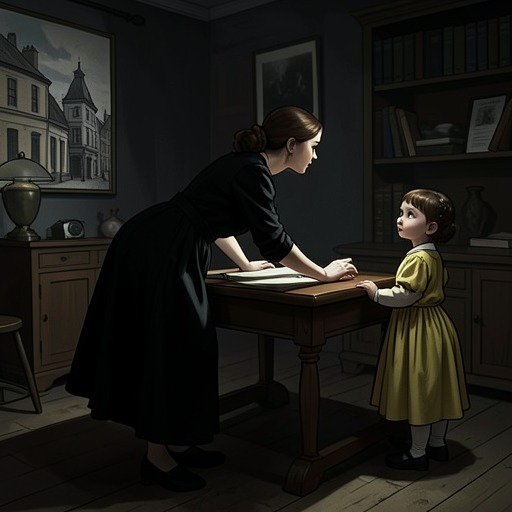
Mademoiselle Poré
Maigret and the Dead GirlMademoiselle Poré is the aunt of Jeanine Armenieu and a crucial source of information about Louise Laboine’s early life in Paris. When Maigret questions her, she recounts finding Louise concealed under Jeanine’s bed and traces the young woman’s arrival, precarious work, and estrangement from Jeanine. Poré’s testimony is valuable but not neutral: she distinguishes what she saw from what Louise told her, while her moral judgments about the younger women sometimes turn suspicion into assumed explanation.
Identity and Position
Poré identifies Jeanine as the daughter of her half-brother. She describes his upbringing of Jeanine as something of which he should not be proud, establishing at once a family connection and her critical view of her niece. Poré’s relationship to Louise is different: Louise is Jeanine’s friend, not the niece Poré initially means when discussing the girl in the photograph. That distinction matters to her account, which links the two young women through a chance meeting rather than through kinship.
Poré explains that she did not go to the police when she saw the photograph because she could not be certain she would recognize Louise after three and a half years. She notes that people, especially young people, can change considerably in that time, and says she dislikes interfering in matters that are not her business. Her hesitation is therefore presented as uncertainty about identification as well as a personal reluctance to intervene, not as proof that she recognized Louise and deliberately withheld her knowledge.
When Maigret visits, Poré draws a chair for him and offers to tell the whole story. She says she keeps the letters she receives, including family correspondence, although Maigret declines to inspect them. Her manner is expansive: she repeatedly signals that she is nearly finished and acknowledges that Maigret is busy. During the interview she directs her attention to him, treating Lognon as a mere extra. The exchange establishes that her testimony is shaped not only by what she remembers but also by the audience she chooses to address.
Jeanine’s Arrival and the Household
Poré recalls that her half-brother wrote to her, she answered, and Jeanine arrived one morning at about half-past seven. Jeanine had chosen a night train despite the availability of good daytime trains; Poré interprets that choice as evidence of her niece’s romantic disposition. Poré says she was working the second shift that week. She also recalls criticizing Jeanine’s clothes and hairstyle and warning that she would become a local byword unless she changed them. The episode shows how quickly Poré places her niece under judgment, even as Jeanine enters her household.
The household’s connection to Louise becomes vivid through an accidental discovery. While doing housework, Poré drops a spool of thread. It rolls beneath Jeanine’s bed, and when Poré bends to retrieve it she sees someone staring back at her. She shrieks, then fetches a poker to protect herself before ordering the hidden person to come out. Relief follows when she discovers that the figure is a woman. Louise’s reply, as Poré recounts it, is that she wants Poré to come out so Louise can get out herself. The brief exchange gives the concealment a physical, cramped reality: Louise has been living beneath the bed, not merely visiting the room.
Louise’s Circumstances and Poré’s Testimony
Poré says the hiding had continued for weeks, perhaps months. Louise had arrived in Paris at about the same time as Jeanine; the two met on the train while travelling third class. Unable to sleep, they spent the night telling each other their life stories. According to Poré, Louise had only enough money to last two or three weeks. The meeting therefore joins a chance beginning to an immediate material insecurity: Louise’s acquaintance with Jeanine begins during a journey, but her need for shelter becomes part of the family household.
Poré reports that Louise found work sticking stamps on envelopes in an office. She says Louise told her that the employer began making advances and that she slapped him. Poré immediately qualifies the story, observing that it was only what Louise had told her and might not be true. That qualification is essential to reading the account: Poré preserves the allegation but does not claim to have witnessed it. Her skepticism also contrasts with the certainty of some of her other judgments, particularly when she speaks about Jeanine’s motives.
Poré further complains that Louise stole food during the weeks she was hidden in the house. Her account does not describe the circumstances of each alleged theft; instead, it presents the food as part of the cost imposed on the household. The complaint makes Louise’s poverty tangible while also revealing the terms on which Poré remembers her presence: need is visible, but so is the resentment it provokes.
Family Rupture and Narrative Significance
Poré says she reprimanded Jeanine over the company she kept. Jeanine later left to live in a hotel room, saying she needed freedom, according to Poré. Poré interprets the move as a desire to entertain men, but this is her inference, not an independently established account of Jeanine’s purpose. When Maigret asks how she learned the name and address of Louise’s mother, Poré explains that she questioned Jeanine and, after hesitating for nearly a week, wrote to the mother. She kept a copy of the letter and cannot say whether it had any effect, though she insists that she warned Louise’s mother.
After Jeanine left, she never returned to Poré or sent her a New Year’s card. Poré says that what little she knows of Jeanine now comes from her half-brother: Jeanine writes to him occasionally, says she is well and working hard, and promises to visit home soon. The contrast is pointed. Poré has no direct contact with her niece, yet continues to evaluate her through family reports and remembered grievances.
As a witness, Poré helps Maigret reconstruct Louise’s arrival and the precarious arrangement that placed her beneath Jeanine’s bed. As a narrator within the investigation, however, she is also a filter: she supplies dates, objects, actions, and reported speech, then overlays them with assumptions about youth, respectability, and motive. Her testimony is strongest when anchored in an observed event—the spool rolling under the bed, the face looking out, the poker in her hand—and more uncertain when it concerns what Louise said or why Jeanine acted. That tension makes her account informative without making it conclusive.